


IDMP as the Global Product Backbone in the AI Era: From Fragmented Data to Structured Knowledge
Author: M Bilal Ashfaq, Senior Consultant, Knowledge Management
Category: Knowledge Management
Format: Blog
Estimated read time: ~6 min
Basel, Switzerland – June 2, 2026
As artificial intelligence becomes increasingly embedded across the pharmaceutical value chain, the challenge is no longer data availability. The real issue is whether product information is structured consistently enough for systems to interpret, trace, and govern reliably.
Across regulatory, clinical, safety, and manufacturing environments, the same medicinal product is often represented in completely different ways. Each function maintains its own identifiers, lifecycle definitions, and operational context. While these systems may work independently, they create significant problems when AI models attempt to connect insights across domains.
This is where understanding the true role of IDMP in the AI era becomes strategically important. Rather than acting solely as a compliance framework, it creates the foundation for a globally consistent product identity that can support AI-ready knowledge structures across the enterprise.
The Fragmentation Problem in Product-Centric AI
Pharmaceutical organisations have historically developed domain-specific representations of medicinal products. Each operational area defines and manages products according to its own priorities, workflows, and regulatory obligations:
- Regulatory systems define authorised products and submission-specific identifiers
- Clinical systems focus on investigational products and study-related usage
- Pharmacovigilance systems track adverse events and safety information
- Manufacturing systems manage formulations, production processes, and batch-level data
Each perspective is operationally valid within its own context. The challenge emerges when organisations attempt to connect these perspectives through AI-driven analytics, automation, or enterprise-wide intelligence initiatives.
Without a shared product backbone, AI systems encounter conflicting identifiers, inconsistent lifecycle definitions, and disconnected relationships between substances, formulations, and presentations.
As a result, models may process enormous volumes of information while still lacking a coherent understanding of the product itself.
The issue is not data volume. It is structural inconsistency.
IDMP as a Structural Shift
IDMP (Identification of Medicinal Products) introduces a standardised framework for defining medicinal products across their lifecycle. It establishes consistency across four core domains:
- substance
- product
- organisation
- referential data
More importantly, leveraging IDMP in the AI era introduces a globally referential product identity that can persist across systems and operational functions.
This represents a major shift from fragmented local records toward a unified product model with explicit relationships and governance.
However, standardisation alone does not create understanding. While IDMP defines what a product is, it does not fully explain how that product evolves over time, why changes occur, or how lifecycle events influence operational interpretation. These dimensions become critical, and must be made explicit, when AI systems are expected to reason across domains rather than simply retrieve information.
Beyond Data, The Missing Layer of Tacit Knowledge
Many critical decisions across the pharmaceutical lifecycle rely on tacit domain expertise.
Safety specialists interpret signals based on historical context and medical judgement. Manufacturing teams understand how variability affects product behaviour in practice. Regulatory experts recognise lifecycle implications that may never appear explicitly within structured datasets.
As a result, organisations may achieve technically correct data models while still lacking operational completeness. AI systems trained on these representations inherit the same limitations, leading to weak reasoning capability, reduced explainability, and growing dependence on implicit assumptions.
The challenge therefore extends beyond standardisation. It requires formalising how experts understand products, states, events, and transitions across the enterprise.
From Structured Data to Structured Knowledge
To operationalise IDMP in the AI era effectively, organisations must move beyond static representations of product information. A more mature approach requires explicit modelling of:
- product states
- lifecycle transitions
- causal relationships
- contextual dependencies
For example, a medicinal product may transition from investigational to authorised status, later becoming withdrawn or reformulated. Each transition carries implications that influence how downstream systems interpret the product.
In practical terms, this means mapping regulatory, clinical, safety, and manufacturing systems to IDMP entities, then making those relationships available through a governed semantic layer. That layer does not replace local systems. It gives them a shared product reference model, so identifiers, lifecycle states, and cross-domain relationships can be interpreted consistently across functions. Once this structure is in place, AI systems are better positioned to operate on a traceable product representation rather than reconcile fragmented records after the fact.
Ontology Driven Conceptual Modelling (ODCM) becomes particularly important here because it allows organisations to formalise these relationships in a machine-readable way. Rather than storing isolated records, enterprises begin constructing executable knowledge structures capable of supporting reasoning, traceability, and explainability.
This is the point where IDMP evolves from a regulatory standard into a true enterprise knowledge backbone.
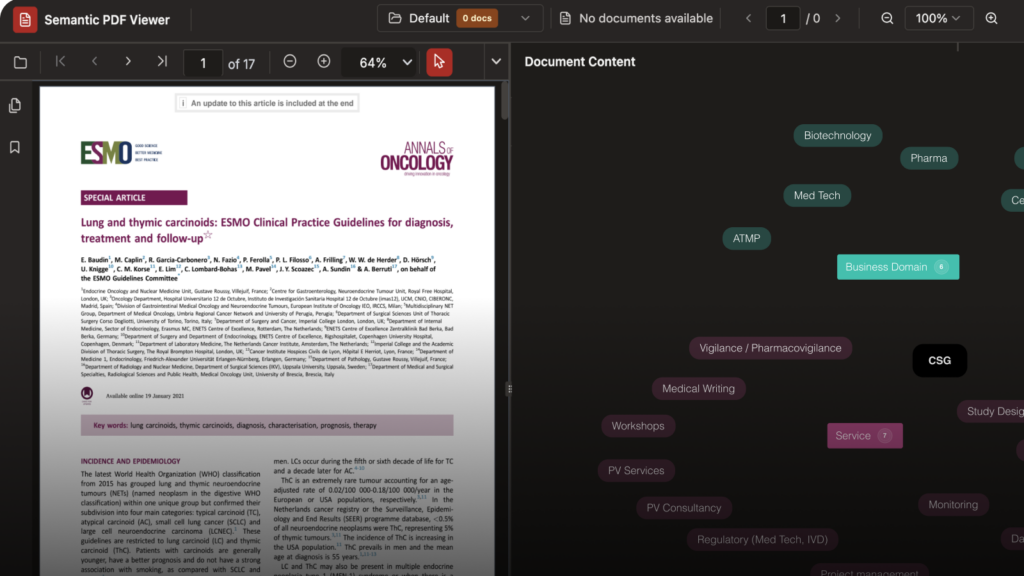
Turn complex documents into AI-ready knowledge graphs
Extract, structure, and query critical scientific knowledge with precision.
Unified Product Identity Across the Lifecycle
When IDMP is combined with structured knowledge principles, organisations can establish a persistent product identity that remains consistent across all operational domains.
This creates alignment between:
- regulatory definitions
- clinical applications
- safety monitoring
- manufacturing operations
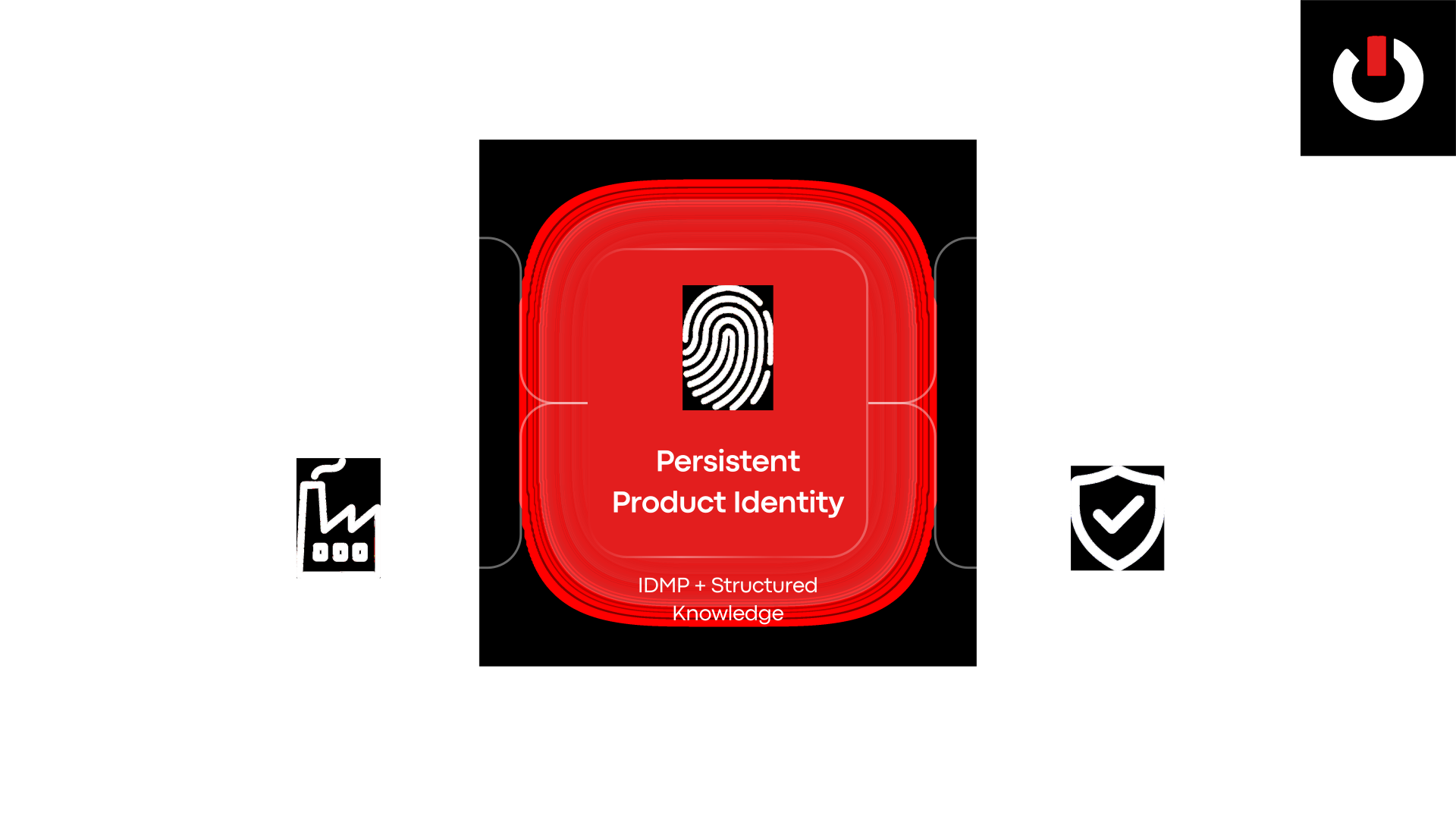
The result is not simply cleaner data architecture. It is a fundamentally more coherent operating model for AI systems. With lifecycle states and causal relationships explicitly defined, organisations gain stronger traceability, improved semantic consistency, and clearer governance across complex processes.
Most importantly, AI outputs become easier to validate because they can be linked directly to structured product context and lifecycle events.
Why IDMP Matters in the AI Era
AI systems in Life Sciences require more than access to large datasets. They depend on contextual integrity and semantic consistency.
Without a unified product backbone, organisations risk scaling fragmentation rather than intelligence. Models may automate decisions faster but still operate on disconnected interpretations of the same medicinal product. A knowledge-driven IDMP framework changes this dynamic by enabling:
- explainable outputs
- cross-domain reasoning
- traceable lifecycle awareness
- stronger governance readiness
This becomes increasingly important as AI adoption expands into regulated decision-making environments where transparency and validation are essential.
What Changes Across the Organisation
Adopting IDMP as a knowledge backbone transforms how organisations operate across the enterprise.
Regulatory functions become more model-driven rather than document-centric. Clinical environments gain stronger alignment between investigational data and global product identity. Safety teams improve traceability between signals and lifecycle states, while manufacturing operations integrate more effectively into a shared product framework.
AI systems move away from pattern extraction over fragmented datasets and toward reasoning over structured, unified knowledge models.
That distinction is likely to define the next stage of AI maturity within Life Sciences.
Conclusion
IDMP represents far more than a compliance initiative. It introduces the structural foundation required for globally consistent product identity in the AI era. When combined with ontology-driven knowledge approaches, IDMP enables organisations to create explainable, traceable, and machine-interpretable product frameworks capable of supporting cross-domain intelligence at scale.
In practice, the challenge is rarely the standard alone. It lies in connecting product data, lifecycle logic, governance, and operational use across regulated environments.
MIGx helps Life Sciences organisations address exactly that by strengthening the context and knowledge structures AI depends on. As AI adoption accelerates, the key question will no longer be whether organisations have enough data. The real differentiator will be whether AI systems can genuinely understand the products they are expected to reason over.
Ready to Make IDMP More Useful?
We help Life Sciences organisations connect IDMP, knowledge modelling, and AI-ready foundations across regulated environments.
FAQs
What is IDMP and why is it important for Life Sciences?
IDMP, Identification of Medicinal Products, is a set of international standards designed to create consistent and interoperable definitions of medicinal products. It helps organisations establish a shared product identity across regulatory, clinical, safety, and manufacturing environments, improving traceability, data quality, and governance.
How does IDMP support AI in Life Sciences?
AI systems depend on consistent and contextual information. IDMP provides a structured product foundation that allows AI models to connect information across functions, reducing ambiguity and improving explainability, traceability, and decision support.
Why is traceability important for AI systems?
Traceability allows organisations to understand where information originated, how it changed over time, and how conclusions were reached. In regulated environments, traceability supports validation, governance, compliance, and confidence in AI-generated outputs.
What is the difference between data and knowledge?
Data represents facts or observations, while knowledge captures the relationships, context, and meaning that allow those facts to be interpreted. Organisations may possess large amounts of data, but without structured knowledge, AI systems often struggle to reason effectively.
What does AI readiness mean in Life Sciences?
AI readiness refers to an organisation’s ability to provide trustworthy, governed, and context-rich information to AI systems. It depends not only on data quality, but also on semantic consistency, traceability, governance, and structured knowledge foundations.
