

Spec-Driven Development for Reliable AI Coding: From Prompts to Governed Delivery

Download the Full Whitepaper
Submit form below and receive the Whitepaper PDF via email:
Author: Diana Gamez, Head of Data & AI Engineering
Category: Innovation & Technology
Format: Whitepaper
Estimated read time: ~16 min
Barcelona, Spain – April 22, 2026
Introduction
AI-assisted coding has changed the tempo of software delivery. A requirement can be described, code can be generated in seconds, and iteration can continue quickly enough to make manual implementation feel slow by comparison.
The gain in speed is real. What matters next is whether that speed produces software that remains clear, reviewable, and controllable once it moves beyond the moment of generation.
In this whitepaper, Diana Gamez, Head of Data & AI Engineering at MIGx, explains why fast output alone is not enough, particularly in environments where software must be understood, challenged, and reviewed against clear expectations. She introduces Spec-Driven Development as a more disciplined way to guide AI-assisted coding, shifting teams from loosely connected prompts towards a governed delivery process.
“Speed, on its own, does not guarantee quality, clarity, maintainability, or control.”
What You’ll Discover
- Why prompt-led development can weaken traceability and introduce structural drift
- How under-specified instructions can lead to unnecessary complexity
- What makes a specification a stronger delivery anchor than a conversational prompt
- How a four-phase workflow improves reviewability and control
- Why Given/When/Then still matters when AI helps implement requirements
- Why this approach is especially relevant in Life Sciences
Vibe Coding and Its Limits
A common pattern has emerged in AI-assisted development. Someone opens an assistant, describes a task in natural language, receives plausible code, and iterates until the result appears acceptable.
That approach can be useful for simple work and early experimentation, but it is also fragile.
When the reasoning behind the implementation is not captured in a durable form, key decisions about architecture, dependencies, error handling, and security can be introduced implicitly by the model rather than explicitly by the team. The code may still run, but the rationale behind it is often unclear.
This is often referred to as vibe coding: development driven mainly by conversational prompting and reaction to generated output. It lowers friction and accelerates early progress, but when intent, scope, constraints, and success criteria remain implied, each new prompt can shift the solution in subtle ways.
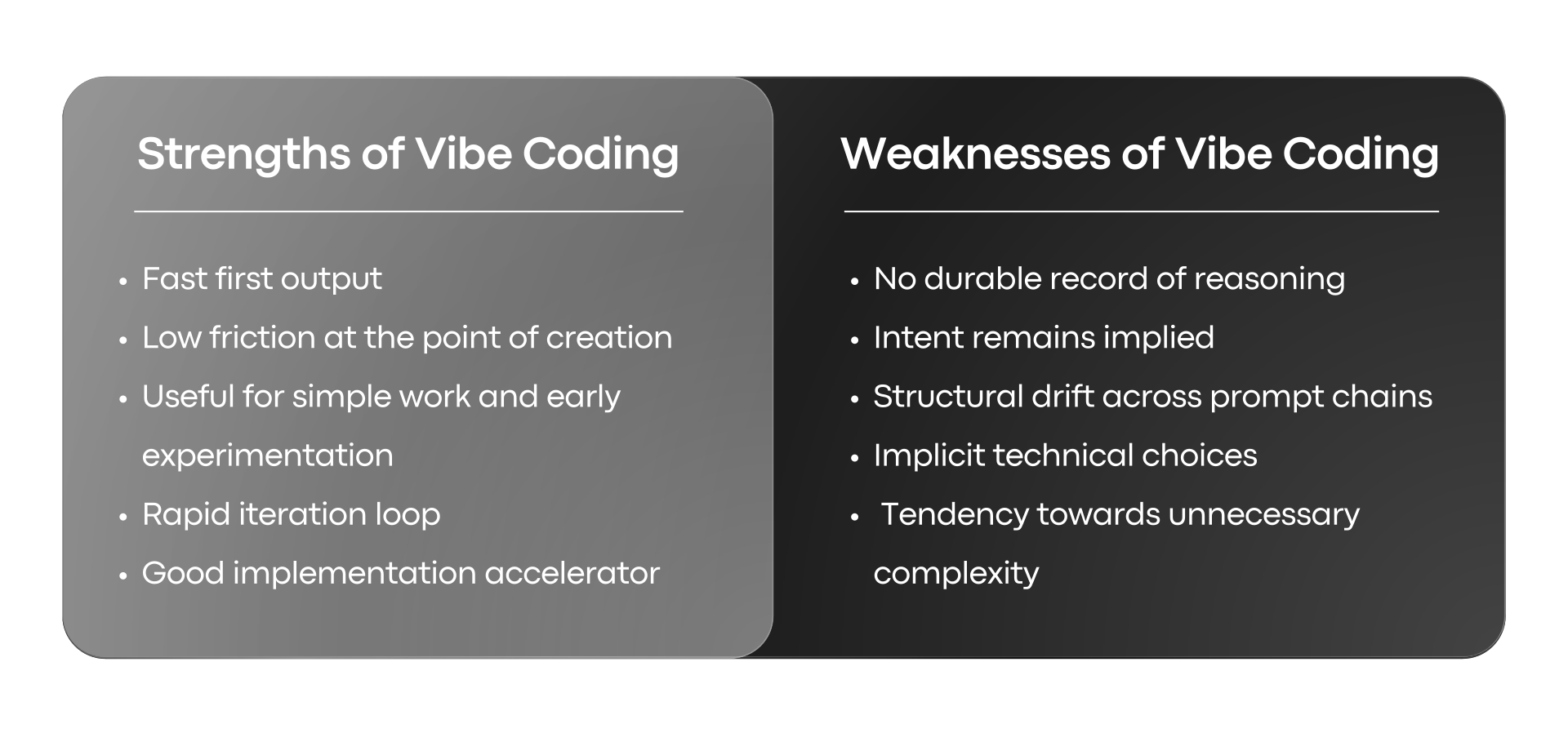
Without a strong specification, AI also tends to optimise for completeness rather than restraint, introducing abstractions or dependencies that go beyond the actual need.
What Spec-Driven Development Changes
Spec-Driven Development shifts the prompt from being the primary driver of implementation to following a structured specification. Teams define behaviour, constraints, and acceptance criteria upfront, and AI works within that scope.
This makes the specification the governing artefact for design and review, keeping decisions explicit and traceable.
Diana summarises the approach as: Spec first. AI executes. Humans steer.
How Spec-Driven Development Works
A disciplined workflow usually follows four phases:
- Specify: Create and review a structured specification defining the feature objective, context, behaviour, edge cases, constraints, exclusions, and acceptance criteria.
- Plan: Use the approved specification to produce a design document covering architecture, interfaces, data structures, validation, dependencies, testing, and integration.
- Generate Tasks: Break the design into small, testable units of work. Each task should be reviewable in one sitting and linked to the specification.
- Implement and Review: Let the AI execute one task at a time. After each task, a human reviews the output against the specification and accepts or rejects it with clear feedback.

The sequence itself is straightforward. What makes it effective are the checkpoints between stages. Each phase has a defined input, a review gate, and a clearer chain from requirement to implementation.
Given/When/Then complements this workflow by providing a simple, structured way to define behaviour clearly, helping both humans and AI align on expected outcomes and reducing ambiguity in implementation.
Why Structured AI Delivery Matters in Life Sciences
The importance of this approach is clearer in Life Sciences, where software must meet strict expectations for traceability, validation, and control. AI-assisted coding remains effective when guided by a clear structure that keeps decisions and outcomes transparent.
A specification-led approach creates a direct chain from intent to implementation. The specification defines requirements, the design outlines how they are met, and the implementation records how the solution evolves. Together, these elements create a clearer audit trail and make it easier to demonstrate alignment with requirements. This reduces the risk of undocumented decisions becoming governance issues later on and strengthens readiness for review and validation.
What Changes Across the Delivery Lifecycle
Spec-Driven Development reshapes how teams work together and how delivery is governed. Business analysts define clearer behavioural expectations, developers work from more explicit inputs, and reviewers assess outputs against agreed criteria rather than assumptions.
This alignment reduces ambiguity and makes each stage of delivery easier to understand, review, and control.
For Life Sciences organisations, this supports a shift from experimentation to a more controlled, robust approach. At MIGx, we help teams apply these principles by strengthening specification design, improving implementation control, and ensuring validation readiness as AI becomes part of everyday delivery.
Ready to Move From Prompts to Governed Delivery?
Submit the form to receive the full whitepaper PDF via email and discover how MIGx helps structure AI-assisted delivery with clear specifications, traceability, and controlled implementation.
Download WhitepaperFAQs
What is vibe coding and where do its limits begin?
Vibe coding is development driven mainly by conversational prompting and reaction to generated output. It lowers friction at creation and makes software feel immediate. Its limits appear when intent, scope, constraints, and success criteria remain implied, because repeated prompts can gradually pull the implementation in different directions.
Why do under-specified prompts lead to unnecessary complexity?
Under-specified prompts leave key trade-offs undefined, so models often optimise for completeness rather than restraint. That can introduce extra abstractions, dependencies, or defensive patterns that solve a broader problem than the team actually has. The issue is usually not model failure, but missing specification.
What is Spec-Driven Development in AI-assisted coding?
Spec-Driven Development is a methodology in which the specification becomes the governing artefact for design, implementation, and review. Teams define behaviour, constraints, edge cases, exclusions, and acceptance criteria before implementation begins, and AI works from that approved scope rather than from an improvised exchange.
Why does Given/When/Then still matter when AI writes code?
Given/When/Then still matters because it turns abstract requirements into explicit behavioural examples. The format defines a starting state, an action or event, and an expected result. In AI-assisted delivery, that clarity reduces interpretation and helps business analysts, developers, testers, and AI systems work from a shared representation of success.
Why is structured AI delivery in Life Sciences especially important?
In Life Sciences, software delivery often needs traceability, validation, controlled change, documented decision-making, and secure handling of sensitive information. A specification-led approach creates artefacts that align more naturally with these expectations and gives teams a clearer chain from requirement to execution.
