

Validating AI Outputs: Why Trusted Context Matters in Life Sciences

Download the Full Whitepaper
Submit form below and receive the Whitepaper PDF:
Author: Cedric Berger, Knowledge Management Lead, MIGx
Category: Knowledge Management
Format: Whitepaper
Estimated read time: ~14 min
Basel, Switzerland – October 6, 2026
Introduction
When validating AI outputs in Life Sciences, increasingly convincing answers are not enough. When AI supports scientific, clinical, regulatory or manufacturing work, organisations may also need to understand which evidence supports an answer, which definitions were applied and how the relevant information connects across systems.
This makes validating AI outputs partly a problem of context. Models can process language remarkably well, but organisational meaning is often distributed across databases, documents, functions and systems. Semantic and graph technologies offer one way to make those relationships more explicit.
Why AI needs more than access to data
Traditional data structures work extremely well when questions and relationships are already understood. The difficulty emerges when an AI system needs to interpret what a study, site, product or data point means in relation to everything around it.
Different teams can use the same term in different ways, while information about one entity may be spread across several systems. Humans often resolve those differences through experience and discussion. Machines need more explicit structure if they are expected to interpret them consistently.
“Meaning, for a machine, is not only a definition. It is a position in a network of relations: what a thing relates to, and how.”
Semantic structures can represent identity, relationships, classifications and provenance explicitly. That gives AI more than access to information. It provides context about how information connects and where it came from.
Why semantic technology is becoming more relevant
Knowledge graphs, ontologies and Semantic Web standards are not new. For years, their benefits included interoperability, reuse and clearer representation of complex relationships, but those benefits were often difficult to translate into an immediate business case.
AI changes that calculation. LLMs and agents make the consequences of missing context more visible through conflicting terminology, weak provenance and answers that are difficult to explain or verify. Gartner’s growing focus on GraphRAG reflects this shift, particularly for enterprise questions that depend on relationships rather than simple document retrieval.
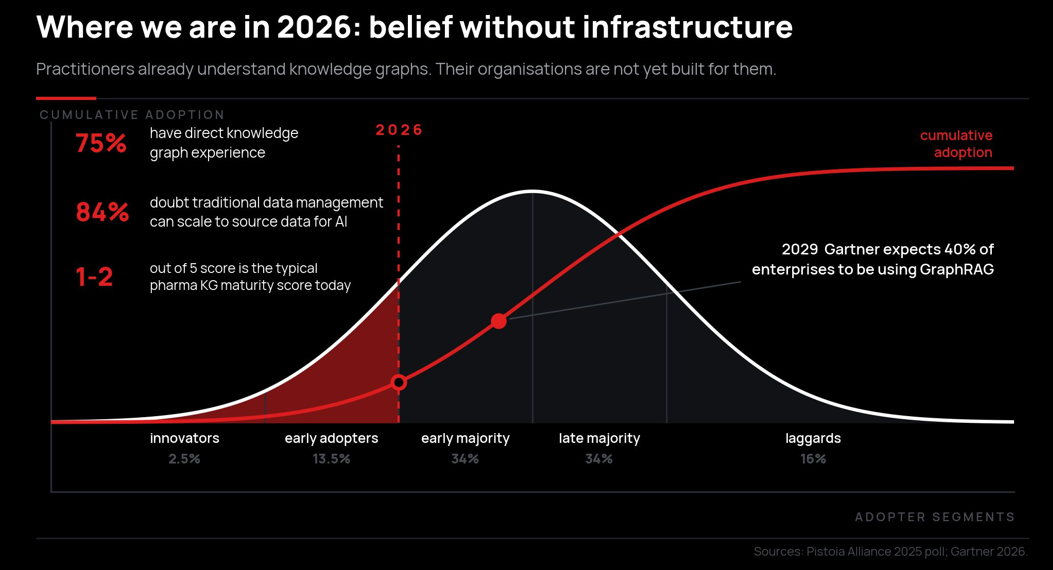
The opportunity is not to use knowledge graphs everywhere. Their value is strongest where a workflow depends on:
- entity resolution and multi-hop relationships
- provenance and evidence chains
- changing definitions or classifications
- traceable rules and decision logic
For simpler lookup tasks, conventional document RAG may still be sufficient.
Why validating AI outputs matters in Life Sciences
Life Sciences combines fragmented terminology with deeply relational scientific and operational data. Targets connect to diseases, compounds to targets, trials to protocols and evidence to the decisions based upon it. At the same time, regulatory and scientific workflows often require provenance and traceability.
The sector also has mature standards and ontologies to build on. FAIR principles have already established the importance of making scientific data findable, accessible, interoperable and reusable. Semantic approaches can extend that foundation by helping information retain meaning as it moves across systems and AI use cases.
One particularly relevant application is decision traceability. An organisation may need to reconstruct which study, data point, rule, definition or prior decision contributed to an AI-supported conclusion. For validating AI outputs, that distinction matters. Traceability does not prove that an answer is correct, but it makes the basis of that answer easier to inspect, challenge and defend.
The full whitepaper explores how this connects to the innovation chasm, GraphRAG adoption and real Life Sciences implementations.
How MIGx Can Help You Build Trusted AI Foundations
Reliable AI depends on more than the model. MIGx helps Life Sciences organisations strengthen the data, context, governance and knowledge foundations needed to make AI-supported decisions more traceable, explainable and dependable.
Frequently Asked Questions About Validating AI Outputs
What does validating AI outputs mean in Life Sciences?
Validating AI outputs means assessing more than whether an answer appears plausible. Depending on the use case, organisations may also need to understand the evidence, definitions, relationships and provenance supporting the output so that it can be inspected and challenged appropriately.
Why does context matter for enterprise AI?
Enterprise information is distributed across different systems, documents and functions. The same concept may also be represented differently in different contexts. Trusted context helps AI systems interpret how information relates rather than relying only on individual data points or document similarity.
How can knowledge graphs help validate AI outputs?
Knowledge graphs make entities and their relationships explicit. They can also preserve provenance and connect information across sources, making it easier to reconstruct the evidence and context behind an AI-supported answer.
Does every AI system in Life Sciences need a knowledge graph?
No. Simpler retrieval tasks may work well with conventional document RAG. Knowledge graphs become more relevant when the problem depends on entity resolution, multi-hop relationships, provenance, changing definitions or traceable decision logic.
What is GraphRAG?
GraphRAG combines knowledge graphs with retrieval-augmented generation. Graph structures can help a system navigate explicit relationships between entities when answering more complex questions.
Why is Life Sciences particularly suited to semantic technology?
Life Sciences combines deeply relational information with fragmented terminology, evidence and provenance requirements, regulatory scrutiny and established domain standards and ontologies.
What is decision traceability?
Decision traceability is the ability to reconstruct the evidence and context behind a decision, including which study, data point, rule, definition or previous decision contributed to a conclusion.
Can semantic technology prevent AI hallucinations?
No. Semantic technology does not guarantee that an AI system will always produce a correct answer. It can provide more structured context, preserve provenance and make relationships explicit, helping organisations inspect the basis of an output.
