

AI Agent Skills in Life Sciences: From General AI to Organisational Expertise

Author: Mike Tatarnikov, Chief Digital Officer
Category: AI
Format: Blog
Estimated read time: ~13 min
Basel, Switzerland – September 22, 2026
AI models are becoming increasingly capable of working with specialised scientific, regulatory and operational knowledge. But having the ability to understand a subject is not the same as defining how to perform a particular task.
This is the gap that Agent Skills in Life Sciences are designed to address: giving AI agents reusable instructions, resources and procedures for specific types of work.
For Life Sciences organisations, that distinction matters. A model may understand regulatory concepts, clinical development or scientific terminology, but it does not automatically know which information your organisation considers authoritative, which exact procedures it must follow, what an acceptable output looks like or where human judgement is required.
What are AI Agent Skills?
An AI Agent Skill is a reusable package of instructions, procedures and supporting resources that guides an AI agent in how to perform a particular type of work. Unlike a one-off prompt, a Skill can capture repeatable workflows, reference material, templates, checks and organisational context for use whenever that task arises.
Several AI platforms now use the term “Skill”, although not every provider uses it in exactly the same way.
Anthropic introduced Agent Skills as organised packages of instructions and supporting resources that an agent can discover and load when needed. The concept has since developed into an open format built around a SKILL.md file, with support extending beyond a single AI platform.
Other providers use “skill” more broadly to describe predefined capabilities or tasks. In this article, we use “Agent Skill”, or simply “Skill”, to mean a reusable package that guides an AI agent in how to perform a particular type of work. They are composable, portable and reusable.
At its simplest, a Skill may consist mainly of natural-language instructions. More advanced Skills can also include templates, examples, reference material, scripts, code and links to other resources or tools.
The important point is not the file format. It is the ability to capture a way of working once and make it reusable whenever an agent encounters the relevant task.
How are Agent Skills different from prompts?
Most people already give AI instructions. They describe the task, provide context, specify the desired output and correct the result when it does not meet expectations.
The problem is that users often recreate this knowledge every time.
A Skill turns repeated guidance into a reusable capability. Instead of expecting each user to remember the right prompt, reference material, sequence of steps and final checks, the Skill itself can contain those elements.
OpenAI describes Skills similarly, as reusable workflows that capture how a task should be performed, including the required inputs, workflow instructions, resources and checks.
That makes Skills particularly relevant in environments where a good result depends on following an established method, not simply generating a plausible answer.
Try it yourself: is the problem understood well enough to solve?
Before designing a solution, it is worth asking whether the problem is understood well enough in the first place.
This Life Sciences Problem Framing Skill is designed to help with that step. It reviews a problem through a Life Sciences lens, including its value-chain context, GxP relevance, supporting evidence, potential impact and any important information that is still missing.
The result is a simple understanding status: INSUFFICIENT, PARTIAL or WELL UNDERSTOOD.
Test the same problem with and without the Skill
First, ask your AI the example below without the Skill. Then add the Life Sciences Problem Framing Skill and submit the same problem again. Compare whether the AI moves directly into requirements and solution design, or first checks whether the underlying problem is sufficiently understood.
Is Your AI Solving the Right Problem?
Test whether a Life Sciences problem is understood well enough before moving into requirements or solution design.
Test whether a Life Sciences problem is understood well enough before requirements or solution design.
1. Identify the primary Life Sciences value chain area.
2. Assess the relevant GxP context.
3. Identify evidence, assumptions and missing information.
4. Apply an understanding gate before solution design.
INSUFFICIENT
PARTIAL
WELL UNDERSTOOD
This is a deliberately simple demonstration. In practice, production Skills can also draw on approved reference material, templates, connected systems, tools and organisation-specific context. This Skill is a Life Sciences adaptation of Dean Peters’ Problem Framing Canvas Skill, based on the MITRE Problem Framing Canvas method.
How do Agent Skills bridge general AI and organisational expertise?
Modern AI models already have broad knowledge across scientific, regulatory and operational domains. What they do not inherently have is an understanding of how a particular organisation expects work to be performed.
In Life Sciences, moving from general capability to useful operational support often requires additional layers of context. First comes specialised domain expertise: the methodologies, standards and common ways of working that are specific to the industry. Beyond that comes the organisation’s own context: how those methods are applied within a particular company.
Agent Skills in Life Sciences can help make those layers reusable, guiding the agent towards increasingly specialised ways of working.
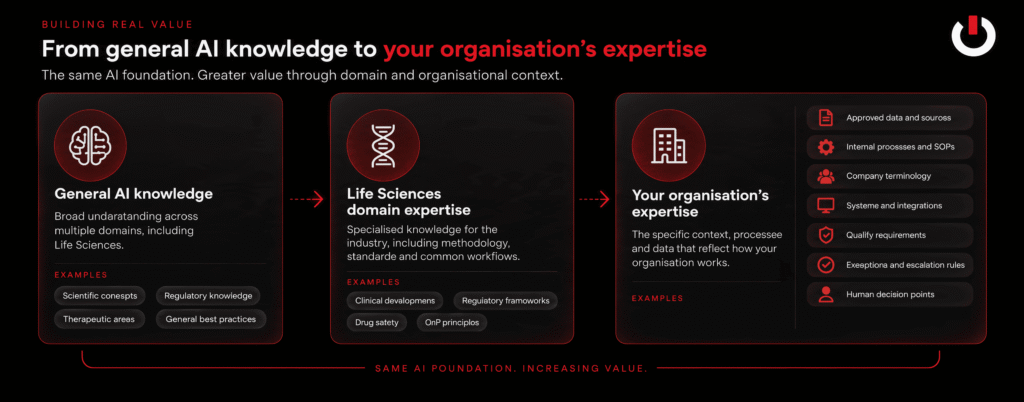
The AI foundation can remain the same while the context around how it is applied becomes progressively more specific. Publicly available Healthcare and Life Sciences Skills can provide part of the domain layer, covering areas such as genomics, drug discovery, clinical data and regulatory workflows.
The real opportunity for Agent Skills in Life Sciences is to go a step further, capturing the context that is specific to how an organisation actually works.
The organisation-specific layer goes further. It introduces the approved sources, internal processes, terminology, systems context, quality requirements and decision points that reflect how work is performed within the company.
What does organisation-specific context add?
The organisational layer does not mean that every piece of company knowledge, data or system access must be placed inside the Skill itself.
Some requirements may be encoded directly in the Skill’s instructions, such as the procedure to follow, the expected output or conditions that require escalation. Other elements may come from approved data sources, connected systems or tools available to the agent.
The important design question is therefore not simply what should go inside the Skill, but what context the agent needs to perform the task correctly, where that context should come from and where human control should remain. Building the technical structure of a Skill is relatively straightforward. Determining the expertise, context and boundaries required around it depends on understanding the work itself.
From a generic Skill to a real Life Sciences capability
This same progression can be seen in a simple example: preparing an internal briefing from a newly published regulatory update.
A general AI model can already summarise the source material and identify potentially relevant points. A Life Sciences Skill can make that process more structured by defining how to analyse the update. An organisation-specific Skill can then add the company’s own procedures, terminology and decision rules.
The progression might look like this:
- General AI: summarises the regulatory update and highlights potentially important changes.
- Life Sciences Skill: applies a defined method, separating regulatory facts, implications, uncertainties and areas requiring further assessment. For example, it can incorporate Good Laboratory Practices and 21 CFR Part 58 into the context.
- Organisation-specific Skill: uses approved terminology, trusted sources, internal templates and relevant business context, while identifying points that require escalation or human review. For example, it evaluates the input in the context of the organisation’s products, markets, internal SOPs and work instructions.
The objective does not have to be full automation. A well-designed Skill can support a defined part of the workflow. Specialist judgement and accountability can remain where they are needed.
How do Agent Skills in Life Sciences connect to data, tools and permissions?
The simplicity of the Skill format should not be confused with simplicity of implementation.
In practice, Agent Skills in Life Sciences form one component within a broader AI capability. Subject matter expertise and company processes help define how the work should be performed. Approved data provides trusted context. Systems and tools allow the agent to retrieve information and interact with the wider enterprise environment.
The Skill brings reusable instructions, resources and task logic together. The agent can then apply them consistently within the workflow.
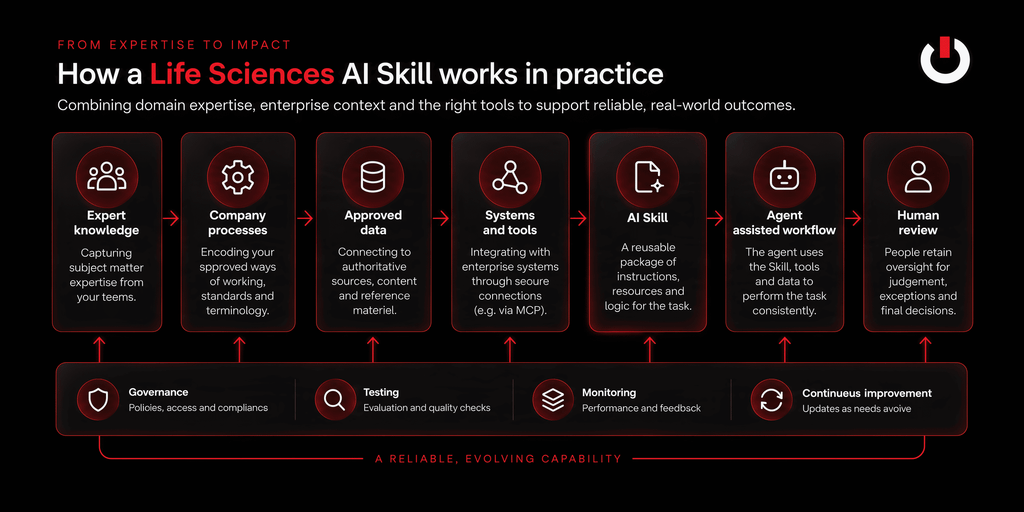
The resulting capability is therefore broader than the Skill itself. The agent uses the Skill alongside the relevant knowledge, data and tools to support the task, while people retain oversight for judgement, exceptions and final decisions where appropriate.
Governance applies across that entire chain. Access controls and permissions determine which information and systems the agent is allowed to use, while testing, monitoring and continuous improvement help ensure that the capability continues to operate as intended.
How can organisations make Agent Skills reliable?
Producing one convincing result is not enough to establish that a Skill works reliably.
A Skill may perform well on an expected task but behave differently when information is incomplete, inputs conflict or a situation falls outside its intended scope. Its behaviour can also be affected when the Skill itself, its supporting resources, connected systems or the underlying AI model change.
Reliability therefore needs to be considered throughout the Skill’s lifecycle, not only when it is first created.
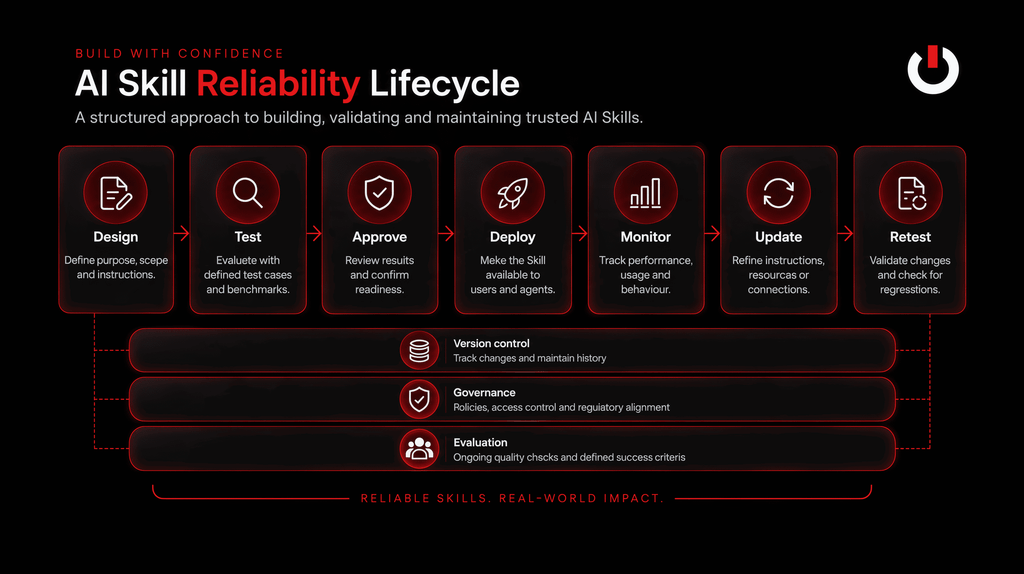
A structured approach starts by defining the Skill’s purpose, scope and instructions. Teams can then evaluate it against representative test cases and defined success criteria before deployment.
Once the Skill is in use, organisations should continue to monitor performance and behaviour. Requirements, instructions, resources, integrations or the underlying model may change. When they do, organisations may need to update the Skill and repeat relevant tests.
Version control, governance and ongoing evaluation provide continuity across that lifecycle. They help organisations understand what changed and assess whether the capability still behaves as expected. They also help identify regressions before they reach real workflows. For Life Sciences organisations, reliability is therefore not a one-time testing exercise. It is an ongoing process of designing, evaluating, monitoring and maintaining a capability within its intended boundaries.
How can Agent Skills become organisational assets?
Once an organisation develops more than a handful of specialised Skills, another question emerges: who owns them?
A Skill can represent more than an AI configuration. It can capture part of the organisation’s accumulated knowledge about how work should be performed.
That makes clear ownership important. Someone needs to understand which process the Skill represents and who should have access to it. They also need to know when its underlying knowledge changes and when to review or retire the capability.
At scale, organisations may therefore move beyond isolated Skills created for individual experiments towards a governed library of reusable capabilities that different agents and teams can draw upon.
The underlying AI model may change over time. The organisational expertise captured and maintained around those capabilities can remain valuable.
Where Life Sciences expertise becomes the differentiator
Creating the basic structure of an Agent Skill is becoming increasingly accessible. The harder question is what expertise should be captured, and what needs to sit around it for the capability to work in practice.
In Life Sciences, that can require understanding scientific and regulated processes, organisational terminology, trusted information sources, enterprise systems and the points where human judgement remains necessary.
This is where MIGx’s broader capabilities connect naturally with Agent Skills: strengthening the knowledge and context AI depends on, supporting secure and GxP-aware technical foundations, and helping organisations move AI capabilities from business analysis through implementation, testing and operations.
A technically correct Skill is only one part of the solution. The real value comes from making organisational expertise usable in a controlled and maintainable way.
Conclusion: The value is in the expertise behind the Skill
AI models will continue to become more capable, while the technical barriers to creating Agent Skills are likely to fall. That makes the organisation-specific layer more important, not less.
For Life Sciences organisations, Skills offer a way to make specialised knowledge and established ways of working reusable across AI agents. But doing that reliably still depends on the right context, trusted information, appropriate system access, testing, governance and human oversight.
MIGx helps organisations work across those layers, combining Life Sciences expertise with the knowledge, infrastructure and implementation capabilities needed to support practical AI adoption.
The model provides the intelligence. The value of the Skill comes from knowing how that intelligence should be applied.
Ready to Turn Your Life Sciences Expertise Into AI Skills?
We help Life Sciences organisations translate domain knowledge, internal processes, approved data and governance requirements into reusable AI Agent Skills that work within real business and regulatory contexts.
FAQs
Do Agent Skills replace SOPs or controlled procedures?
No. A Skill can help an AI agent apply an approved procedure consistently, but it should not automatically become the authoritative source for that procedure. In controlled environments, organisations still need to determine where approved documentation resides, how the organisation governs changes and how the Skill remains aligned with the current process.
How are Agent Skills different from retrieval-augmented generation (RAG)?
RAG is primarily concerned with retrieving relevant information and providing it to an AI model. A Skill focuses on how a task should be performed. The two can work together: retrieval can supply authoritative context, while the Skill defines how the agent should interpret, process or use that information within a workflow.
How are Agent Skills different from fine-tuning an AI model?
Fine-tuning changes aspects of model behaviour through additional training. A Skill keeps task-specific instructions and supporting resources outside the underlying model, making them easier to inspect, update, version and reuse. The appropriate approach depends on the behaviour an organisation needs to achieve and control.
Can several Agent Skills be used within the same workflow?
Potentially. A workflow may require different specialised capabilities at different stages, and some AI environments can select or combine Skills according to the task. Where multiple Skills interact, organisations should also test their combined behaviour rather than assume individually reliable Skills will always work reliably together.
When might an Agent Skill not be the right solution?
A Skill may add little value when a task is simple, genuinely one-off or does not depend on a repeatable method. It may also be inappropriate to use a Skill as an autonomous decision-maker where specialist judgement, accountability or human oversight is required.
Sources
Anthropic, Equipping agents for the real world with Agent Skills
AWS, Agent Skills for Healthcare & Life Sciences
Google Cloud, Behind the scenes: How we build, test and scale Google Agent Skills
Dean Peters, Problem Framing Canvas Skill
eCFR, 21 CFR Part 58: Good Laboratory Practice for Nonclinical Laboratory Studies
