

Pharma Launch Readiness: Why Intelligence Must Start Before Day One

Download the Full Whitepaper
Submit the form below to receive the full whitepaper PDF:
Authors: Luca Morreale, Chief Customer Success Officer, MIGx & Thomas Frei, Executive Client Director, Athagoras
Category: Knowledge Management
Format: Whitepaper
Estimated read time: ~14 min
Basel, Switzerland – November 4, 2026
Introduction
Pharma launch readiness is often judged by what is in place when a product reaches the market. Yet many decisions that shape launch success are made much earlier, while evidence is still developing and assumptions about patients, healthcare professionals (HCPs), access and competition are being tested.
In this whitepaper, Luca Morreale and Thomas Frei examine how connected evidence, stakeholder insights and emerging signals can help organisations challenge assumptions earlier, direct investment more effectively and make better-informed decisions before and after Day One.
Why pharma launch intelligence needs to begin earlier
As regulatory approval approaches, launch investment often accelerates sharply. Organisations build commercial teams, implement systems and introduce new capabilities within a compressed timeframe. For emerging biopharma companies with finite resources, making those investments years in advance may be neither practical nor financially viable.
The problem arises when the intelligence needed to guide those choices is also left until late in the process. Critical data sources, market insights and stakeholder intelligence may remain fragmented, leaving less time to challenge assumptions or identify gaps in evidence before significant investments are committed.
The cost of building intelligence too late
IQVIA research found that its top-performing launch cohort spent nearly twice as much on research and involved twice as many HCPs as competing launches. The appropriate timing and level of investment still depend on how well the therapy and market are understood.
Rather than implementing every capability at once, organisations can prioritise the decisions that matter most, identify which information is needed to support them and establish the capabilities required to capture and connect that intelligence.
What should companies understand before Day One?
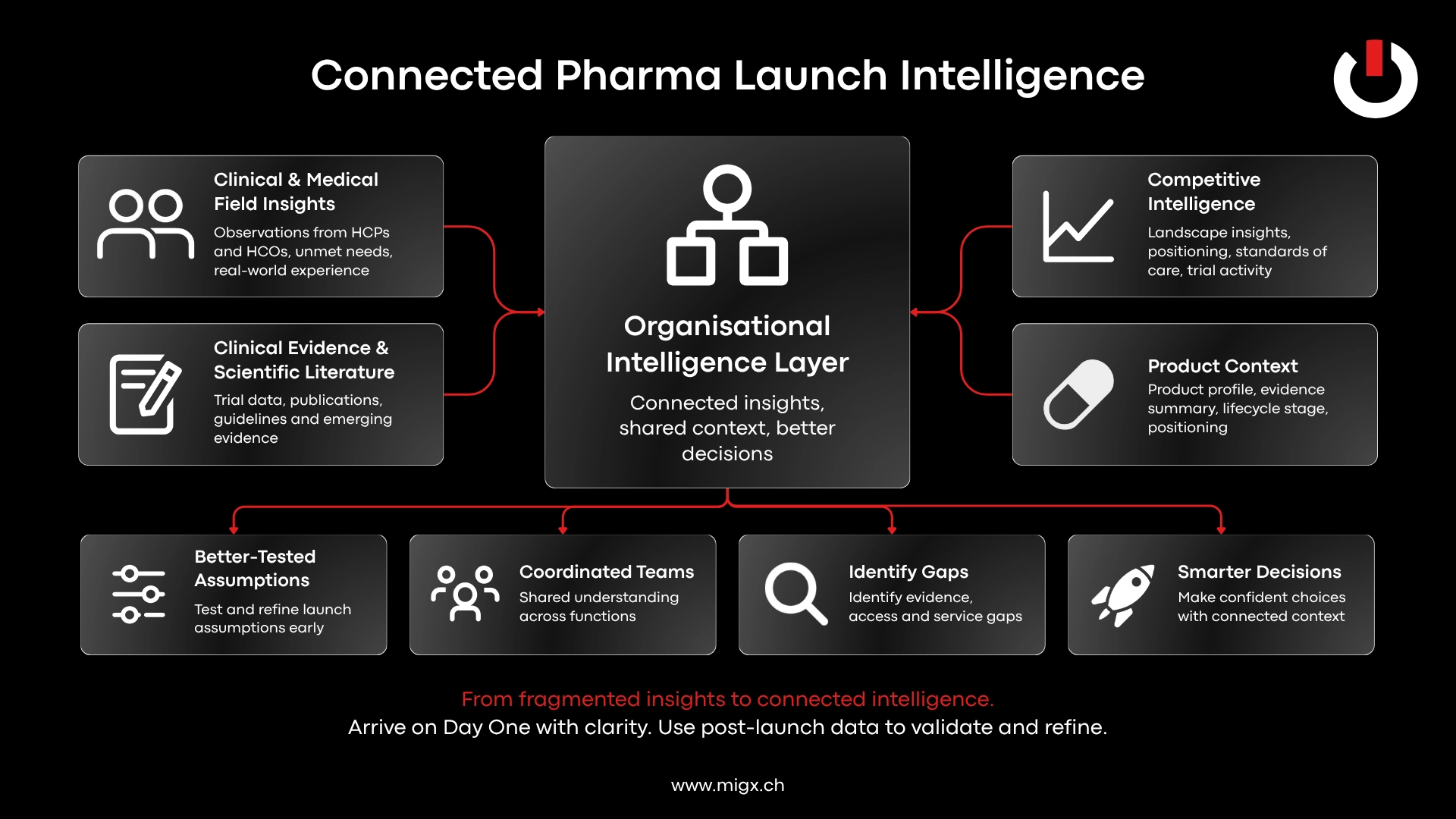
Clinical Development, Medical Affairs, Market Access, Commercial and HEOR teams each develop part of the picture. Scientific evidence may sit apart from field observations, competitive intelligence or product context.
The challenge is connecting these perspectives in a way that strengthens decision-making while maintaining appropriate governance boundaries. Effective knowledge management can help organisations preserve and share valuable context across functions.
“I think the more important question isn’t ‘what do they need?’ but ‘how do they share it?’”
Luca Morreale, Chief Customer Success Officer, MIGx
Individually, these information sources provide partial answers. Connected through a governed launch intelligence capability, they give decision-makers a stronger basis for understanding which assumptions are supported, where evidence is missing and which decisions could be affected.
Testing assumptions while there is still time to act
Every launch strategy is built on assumptions about disease burden, patient populations, treatment pathways, HCP behaviour, market access, competition and demand.
Some assumptions will remain valid. Others may weaken as new evidence emerges. The greatest risk is discovering an incorrect assumption too late, after organisations have already committed significant investments and developed their launch plans around it.
Before launch, organisations should be able to answer three important questions:
- Which launch assumptions have the greatest impact on success?
- What evidence supports them today?
- Where are knowledge gaps, conflicting signals or blind spots still hidden?
The answers differ by therapeutic area. In rare disease, understanding the patient landscape, referral pathways and centres of expertise can influence early decisions. In obesity, competition, reimbursement models and healthcare capacity may change quickly. For novel antibiotics, appropriate availability, access and utilisation can matter more than prescription volume alone.
These different environments call for different intelligence priorities, but the underlying principle is consistent: evaluate assumptions while there is still time to respond to new evidence.
How Generative AI helps make unstructured information usable
Medical notes, interview transcripts, field observations, scientific literature and competitive intelligence reports contain valuable information relevant to launch decisions. Teams capture much of this knowledge in narrative form across documents and systems. This makes it difficult to analyse and connect consistently.
Generative AI can help organisations work with this unstructured information at scale, making previously difficult-to-access knowledge more available for decision-making.
Why context matters as much as the model
AI alone does not create launch intelligence. Its effectiveness depends on the quality, structure, relationships and governance of the information available to it.
This is where semantic technologies and knowledge graphs become relevant. They can connect information across functions while preserving meaning, context and traceability. Combined with governed product knowledge, they can help teams relate emerging signals to the assumptions behind launch decisions.
The objective is to make evidence discoverable, connected and actionable, so that new information can strengthen, weaken or change the assumptions guiding strategic choices.
Moving from systems readiness to intelligence readiness
Systems readiness ensures that the technology, teams and processes required for launch execution are operational. Intelligence readiness ensures that organisations connect evidence, insights and emerging signals across functions, allowing them to evaluate assumptions before and after launch.
Operational reporting remains essential once execution begins. It helps determine whether real-world performance validates earlier assumptions or requires adjustment.
Continuous readiness extends this principle further, maintaining the ability to challenge assumptions and respond as evidence and market conditions change.
Day One should validate intelligence, not create it
A successful launch depends on decisions made months or years before a product reaches the market. Organisations that can connect evidence, identify knowledge gaps and challenge critical assumptions earlier are better positioned to direct investment effectively and adapt as new information emerges.
For business and IT leaders, this means starting with the decisions that matter, then determining which information and capabilities they need to support them. Technology should follow decision-making priorities, rather than determine them.
How MIGx can help you build launch intelligence
MIGx helps biopharma organisations assess their launch intelligence maturity, identify capability gaps and build the foundations for intelligence readiness and continuous launch excellence.
Through capabilities spanning data integration, knowledge management, semantic technologies, governance and AI-enabled knowledge discovery, MIGx supports organisations in connecting evidence and making information more useful for strategic decisions.
Contact MIGx to discuss how connected evidence and knowledge management could support your pharmaceutical launch preparation.
For a deeper examination of launch intelligence across rare disease, obesity and antibiotics, including practical examples and the role of connected knowledge, download the full whitepaper.
Frequently Asked Questions About Pharma Launch Readiness
What is pharmaceutical launch intelligence?
Launch intelligence connects scientific evidence, stakeholder insights, product knowledge and market signals so teams can test assumptions and make better-informed decisions before and after launch.
How does intelligence readiness differ from systems readiness?
Systems readiness concerns the technology, processes and teams needed to execute a launch. Intelligence readiness concerns whether evidence and context are sufficiently connected to assess the assumptions guiding decisions.
When should companies start building launch intelligence?
The timing should follow the decisions that need support. Useful insights may emerge during investigator engagement and evidence planning, well before commercial launch infrastructure is built.
Which functions contribute to launch intelligence?
Clinical Development, Medical Affairs, Market Access, HEOR and Commercial teams contribute different perspectives. Their evidence needs to be connected while maintaining appropriate governance boundaries.
What launch assumptions are worth testing before Day One?
Priorities vary by product and therapeutic area. They can include assumptions about the patient journey, unmet need, evidence requirements, reimbursement, competition and demand.
Can Generative AI improve pharmaceutical launch readiness?
Generative AI can help analyse narrative sources such as field observations, interviews and reports. Its value depends on the context, quality, relationships and governance of the underlying information, as well as human interpretation.
Why does launch intelligence remain important after approval?
Post-launch information can confirm or challenge assumptions made during development. Connected intelligence helps teams interpret real-world signals and adjust decisions as evidence and market conditions change.
