


Shadow AI in Pharma: Govern the Access Path Before Data Moves
Author: Roman Dushko, Enterprise Security Lead
Category: Infrastructure & GxP
Format: Blog
Estimated read time: ~8 min
Basel, Switzerland – August 11, 2026
When people need an answer quickly, they usually choose the fastest route. In regulated environments, that often means Shadow AI in Pharma begins with an ordinary task rather than an intentional policy violation.
A deviation summary needs drafting before the end of a shift, the approved process is slow, and someone reaches for the AI tool that is already open.
The useful question is rarely, “Which AI tool was used?” The better question is: what route did the data take, and could anyone control it before sensitive information had already left?
“Tool approval often gets treated as the control. In practice, it is only the start.”
A tool can be approved and still be poorly governed until someone has defined what data it can access, what it can retain, which identity it acts under, which connector it can use, and what evidence remains afterwards.
In Life Sciences, organisations need to own, limit, monitor, approve, change, retire, and evidence that route. This applies whether the workflow supports pharmaceutical manufacturing, clinical development, pharmacovigilance, quality operations, or proprietary research.
This is the same control problem raised in MIGx’s earlier article on the risks of AI in Life Sciences. Building or buying AI works only when governance, validation, and supplier oversight remain close to the actual use case.
Shadow AI in Pharma Is a Workflow Signal
When the Approved Route Is Too Slow
Shadow AI in Pharma usually starts with a real business need. Someone needs to summarise, draft, search, compare, translate, classify, or clean up text. If the approved process is too slow, too restricted, or ownership is unclear, people will find another way.
That behaviour is a design signal. It shows that the control has missed the workflow.
Blocking public AI endpoints may reduce visible usage, but the work still exists. A stricter policy may move the behaviour into a personal account, a browser extension, a copied dataset, or a tool outside the review process.
The people responsible for governance can then lose visibility into that data movement. In a pharmaceutical environment, that hidden route may involve deviation records, clinical information, safety narratives, validation documents, or commercially sensitive research.
The answer is an approved path that is fast enough to use, with clear boundaries around data classification, identity, connectors, permitted actions, retention, and approval..
Why Tool Approval Alone Cannot Stop Shadow AI Data Leakage
“Approved by IT” is a label. Teams still need to design the boundary.
Tool Approval vs. Data Boundary Controls in Pharma
Addressing Shadow AI in pharma effectively means recognising that an approved assistant can still create exposure if it retrieves too much, retains too much, or sends information into an environment designed for a different data classification.
An enterprise AI service may offer stronger controls than a consumer chatbot, but the label becomes meaningful only when the organisation understands the logs, conversation history, administrative access, abuse monitoring, contract terms, retention, deletion, data residency, subprocessors, and audit evidence.
For low risk drafting, provider commitments and appropriate configuration may be sufficient. For identifiable patient data, regulated evidence, clinical study context, or proprietary research, the follow-up questions need to be much sharper.
What exactly entered the system? Where was it processed? Can it be recovered, deleted, or evidenced under the actual service configuration and contract terms?
For identifiable patient or health data, strict containment should remain the default. Organisations should use external AI services in these workflows only when they have designed the environment, contract, validation approach, auditability, privacy review, supplier obligations, data transfer position, and technical controls for that data class.
In practice, this means minimising the information shared, masking or pseudonymising data where appropriate, separating patient data systems, and using data loss prevention controls that can reduce, block, or flag sensitive content before it reaches unmanaged AI endpoints.
“If the question “Where exactly did that patient text go?” makes the room uncomfortable, the control needs to be stronger.”
How AI Agents Change the Risk Profile in Pharma
AI risk changes when the assistant stops behaving like a text box and begins acting through connectors, credentials, workflows, plugins, or internal systems.
An agent that retrieves records, opens a service ticket, drafts a regulated response, or triggers a workflow is acting with delegated authority. Whether it acts through delegated user access, a workload identity, a service account, or its own runtime identity, the fundamental question remains the same.
What can this actor do, for whom, under which conditions, and with what audit trail?
In Pharma, that route may reach a clinical narrative, a safety case, a validation artefact, batch release context, or supporting evidence. If the agent changes regulated content, teams need to assess the validation impact, approval authority, and audit evidence.
At that point, productivity is no longer the metric that matters most.
Managing Shadow AI in Pharma: Policy Has to Follow the Action
If an assistant connected to document repositories, regulated records, validation folders, ticketing workflows, or clinical documentation retrieves information on behalf of a user, the login event is only the beginning.
The policy decision has to follow the delegated action. Who initiated the request, and which agent performed it? What connector and environment were involved? Which data classification applied? What action did the user request, and what business context justified it?
Zero Trust for AI Agents in Pharma
NIST’s Zero Trust Architecture makes the same point for infrastructure generally. Organisations should stop trusting network location and evaluate individual requests on their own terms.
The Zero Trust implication for AI agents is straightforward. A successful login authorises the start of a session. It should not automatically authorise every delegated action that follows.
- Least privilege defines both what the user can access and what the agent can access on the user’s behalf.
- Separation of duties must continue to apply when work is delegated to an AI agent.
- Access policy, data loss prevention, workload identity controls, connector allow listing, and transaction-level approval should evaluate identity, data context, environment, and action together.
- Human approval should remain in front of regulated record modification. If manual clean-up becomes the normal control, the design needs to be reviewed.
The flow below shows the access decision in one picture: agent identity, data classification, allowed capability, human approval where required, and one audit trail.
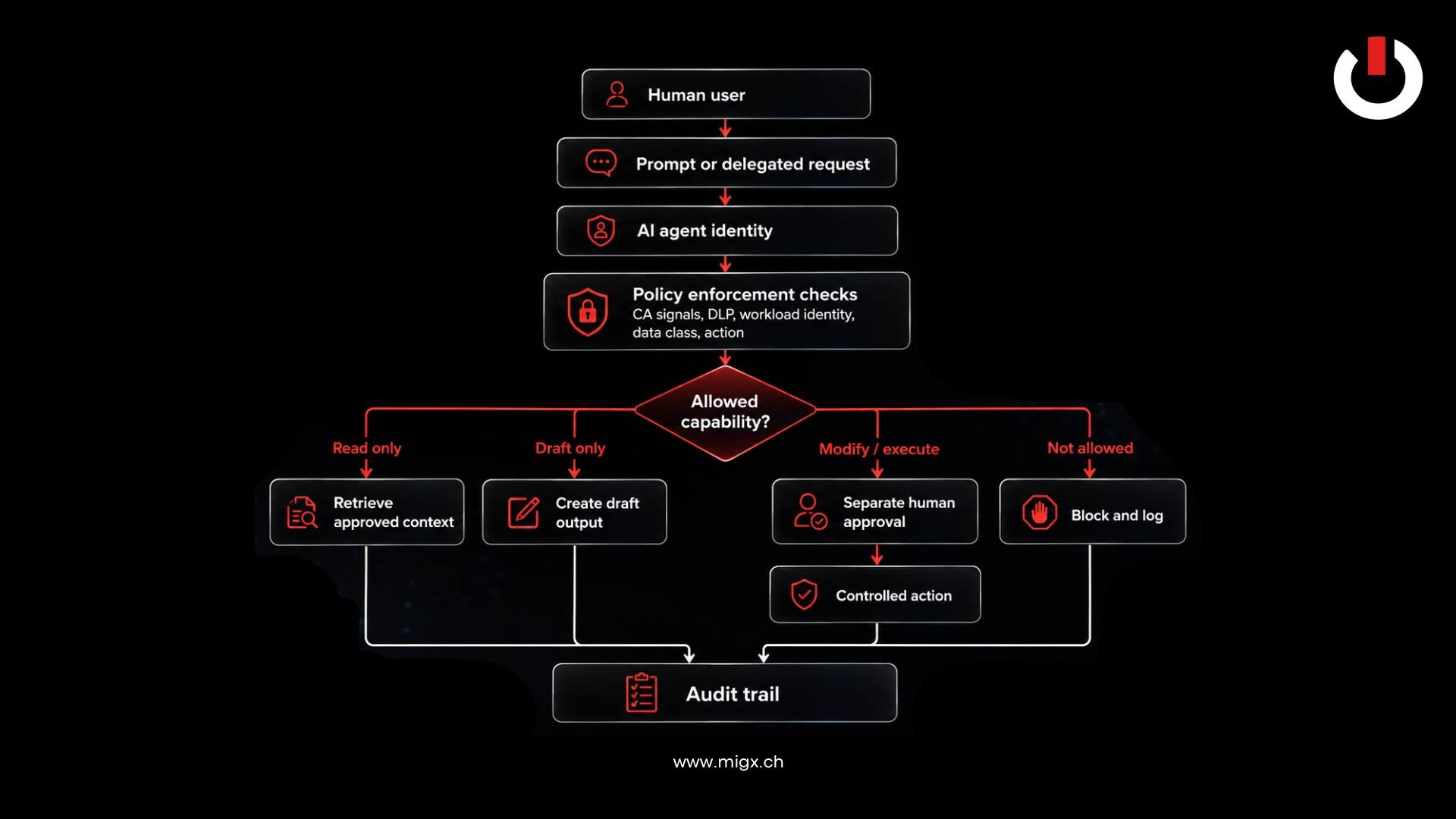
The Cloud Security Alliance makes the same data movement case for healthcare. Simple allow or block thinking is too blunt once sensitive information can move through AI tools. OWASP makes the identity point from the agent side. An agent with unclear privileges can become an abuse path. In Life Sciences, those two threads meet in a more serious place. The same failure can affect a clinical record, safety case, validation artefact, or batch release decision.
Use up and down arrow keys to resize the meta box pane.
A Pre-Pilot Review Using NIST’s AI Risk Management Framework
These questions belong in the room before the pilot quietly turns into the tool everyone depends on.
Use the NIST AI Risk Management Framework as the starting point by working through Govern, Map, Measure, and Manage. For Life Sciences organisations, that assessment also needs to consider the evidence required to support audits, inspections, change control, and data integrity throughout the AI lifecycle.
- Govern: Who owns the use case, agent identity, approval path, supplier review, residual risk, and kill switch?
- Map: Which users, systems, connectors, data classes, jurisdictions, regulated records, and downstream decisions are involved?
- Measure: What can go wrong, and how would anyone know? Test wrong data, wrong answer, and wrong context, along with prompt injection, over-permissioned access, missing audit trails, data leakage, and validation impact before the tool becomes business critical.
- Manage: Which controls enforce the decision? Can the identity be disabled, the connector blocked, the secret rotated, or the workflow quarantined quickly?
- Evidence: Can the organisation trace who submitted the request, which agent acted, what it accessed, what it produced, who approved it, what changed, and why the result was considered acceptable?
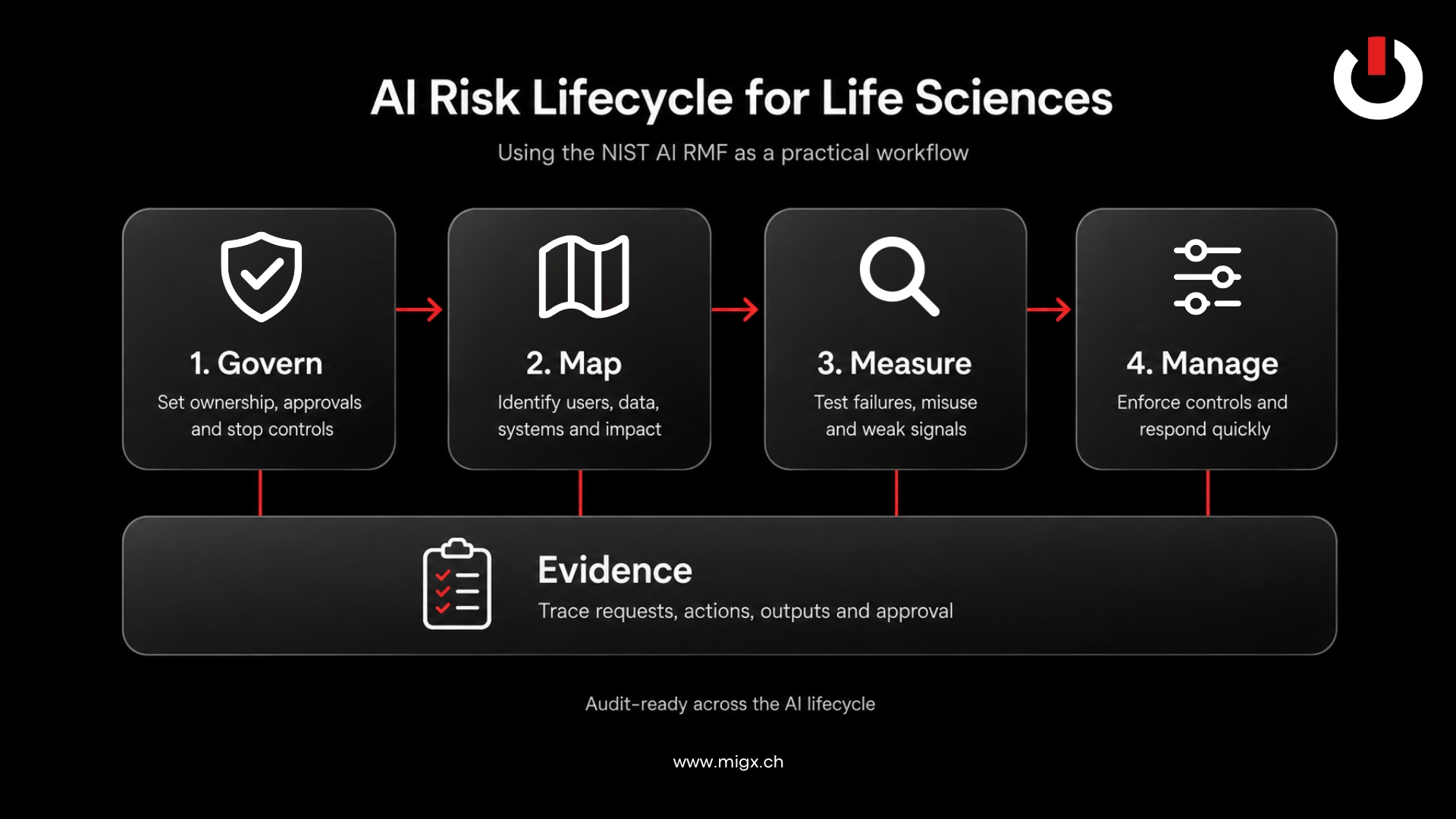
The practical next step is straightforward. Select one real AI workflow, map the access route, assign an owner, test patient and regulated data handling, and verify the kill switch before the pilot becomes normal business practice.
Data Integrity and Regulatory Compliance Risks in Life Sciences
In Life Sciences, confidentiality is only the starting concern. The data, the decision, and the supporting evidence all need to withstand future scrutiny.
Manufacturing, clinical, safety, validation, and privacy teams answer different questions. Each function needs a defined route into the approval decision. Health-related data also raises the control expectation, whether an organisation is working under European, Swiss, or US privacy requirements.
The European regulatory direction and US regulatory direction point towards the same operational message: AI governance depends on appropriate documentation, human oversight, lifecycle control, and evidence that can withstand regulatory scrutiny. For Life Sciences organisations, the challenge is not waiting for future guidance. The challenge is applying those principles to the AI systems they already use today.
Return to the deviation summary from the introduction. If an inspector asks about it six months later, saying that “an AI tool helped draft it” is an incomplete answer.
The real questions are more specific. Which model or service produced the draft? What source records did it access? Who reviewed the draft against the source evidence before approval? Can the organisation still trace, reconstruct, review, and evidence that chain today?
That is what regulated data integrity means once AI becomes part of the workflow. The record has to remain defensible when an inspector questions it months later.
Operationalizing AI Governance for Life Sciences with MIGx
MIGx helps Life Sciences teams turn AI governance into operational controls. This includes mapping the real workflow before a pilot becomes a production dependency, defining the access route across users, agents, connectors, data classes, and approval points, and building evidence that can withstand audit, inspection, and incident review.
Secure the Data Path to Eliminate Shadow AI Risk
Shadow AI in Pharma and approved AI ultimately fail for the same reason. Organisations stop at tool approval instead of governing the route underneath it.
The real control point is the route itself: which data the system can access, which identity it uses, which connector it relies on, which action it performs, and what evidence it leaves afterwards.
For regulated Life Sciences organisations, AI governance is no longer about deciding whether people will use AI. It is about ensuring every AI-assisted workflow remains controlled, traceable, and defensible.
Ready to Bring Shadow AI Under Control?
We help Life Sciences organisations map AI access paths, strengthen identity and connector controls, and build the governance, monitoring, and evidence needed to keep sensitive data within controlled workflows.
FAQs
What is Shadow AI?
Shadow AI is the use of AI tools or workflows outside an organisation’s approved or governed processes. It often begins with a legitimate business need when the approved route is too slow, too restricted, or unclear, leading users towards personal accounts, public AI services, extensions, or other unmanaged tools.
What is the difference between Shadow AI and Shadow IT?
Shadow IT broadly describes technology used outside formal organisational oversight. Shadow AI applies that problem specifically to AI tools and workflows, where additional questions arise around what data is processed, retained, retrieved, or accessed through connectors and delegated identities.
What are the main security risks of Shadow AI?
Key risks include sensitive data leaving controlled environments, excessive permissions, unmanaged connectors, unclear identities, and missing audit evidence. The exposure becomes greater when AI tools can retrieve information or take actions through internal systems and regulated workflows.
How can Shadow AI affect compliance?
Shadow AI can make it difficult to show where sensitive information was processed, who accessed it, what was retained, and what actions were taken. In Life Sciences, this can create challenges for privacy, validation, data integrity, supplier oversight, auditability, and regulatory evidence.
Why is Shadow AI especially risky in Pharma?
Pharma workflows may involve patient information, clinical records, safety narratives, deviation records, validation documents, manufacturing data, or proprietary research. If that information moves through an unmanaged AI route, visibility, control, traceability, and defensible evidence can quickly be lost.
