


Why IDMP Goes Beyond Traditional Master Data Management: Where MDM Starts to Fall Short
Author: M Bilal Ashfaq, Senior Consultant, Knowledge Management
Category: Knowledge Management
Format: Blog
Estimated read time: ~12 min
Basel, Switzerland – June 23, 2026
In the previous post in this series, we explored how IDMP represents a structural inflection point for the Life Sciences industry. Not simply as a compliance requirement, but as the foundation for a globally consistent product identity that can support AI-ready knowledge structures across the enterprise.
The natural question that follows is straightforward. If an organisation already operates a mature Master Data Management (MDM) platform, why is that not sufficient? Why does IDMP require something more?
This is not a theoretical concern. It is often one of the first questions raised when organisations begin their IDMP master data management journey. MDM platforms already manage product information, substance identifiers, and regulatory attributes. Extending those capabilities appears logical. The challenge is that IDMP is not fundamentally a data quality problem. It is a semantic precision problem, and the IDMP semantic layer is where that distinction becomes operational.
“MDM answers whether product data is consistent. IDMP answers whether product meaning is consistent.”
Understanding that distinction is often the difference between an implementation that merely stores compliant data and one that establishes the foundations for AI-ready product knowledge.
Why MDM Seems Like the Natural Starting Point for IDMP
Master Data Management exists to solve a real and persistent challenge. The same medicinal product often appears under different names, identifiers, and structures across ERP platforms, regulatory systems, clinical applications, pharmacovigilance environments, and commercial databases.
MDM addresses this fragmentation by creating a trusted golden record. It improves consistency, supports governance workflows, and synchronises critical information across operational systems.
For pharmaceutical organisations, this fragmentation is particularly visible because product information is spread across regulatory, clinical, safety, manufacturing, and commercial environments. Each function relies on product data but often interprets and manages it through a different operational lens.
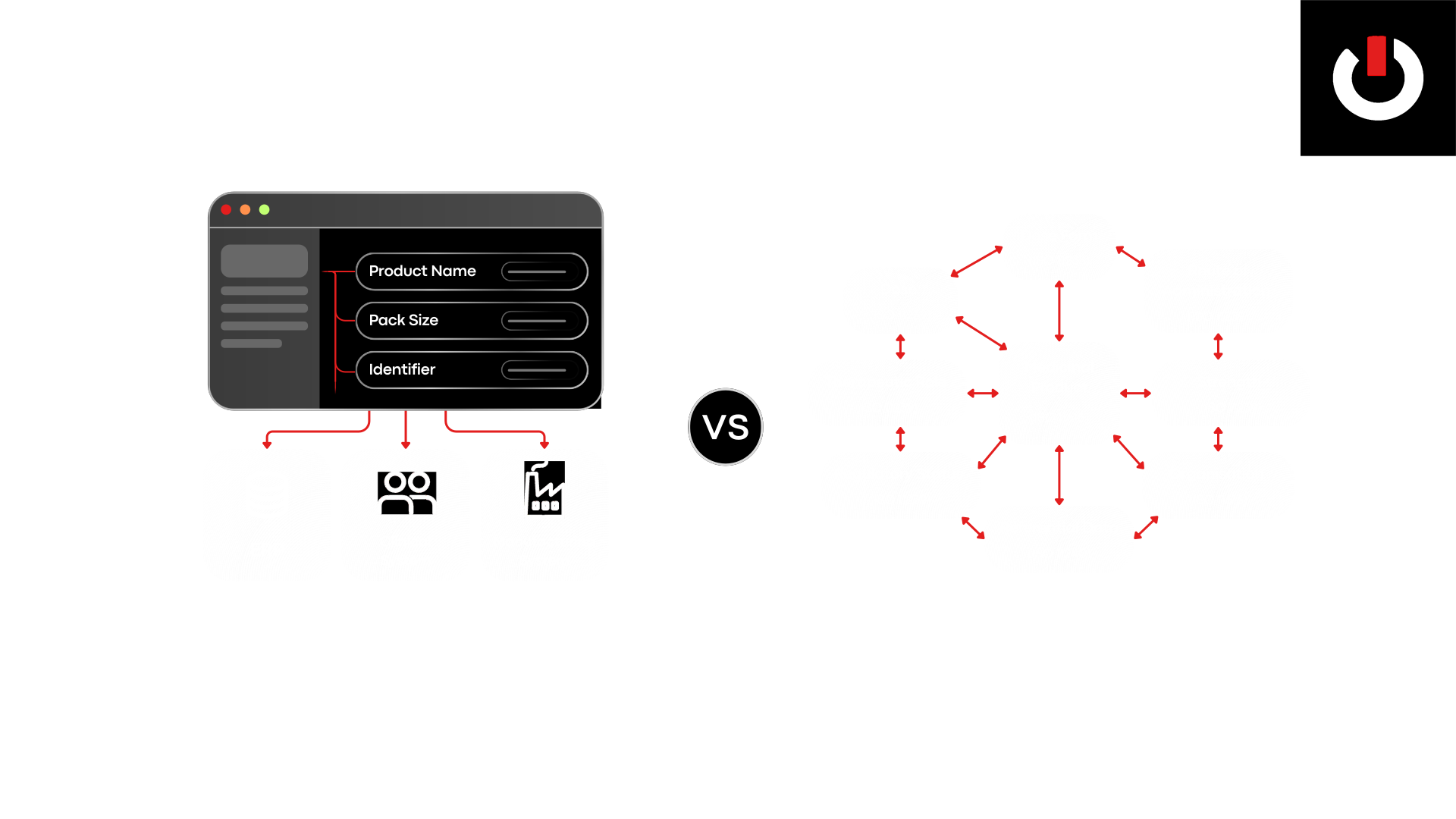
For the questions MDM was designed to answer, it performs extremely well. Which products contain a particular active substance? What pack size is authorised in a given market? Who approved the latest update to a product record?
These are governance and data management questions, and MDM is purpose-built to answer them.
When IDMP enters the conversation, it is therefore understandable that organisations approach IDMP master data management by assuming their existing MDM platform can simply be extended to accommodate the new requirements.
This is where many implementations begin to encounter limitations.
What IDMP Requires Beyond Master Data Management
The previous article established that IDMP creates a globally referential product identity built on standardised definitions of substances, products, organisations, and referential data.
What is often overlooked in IDMP master data management is that IDMP is not primarily concerned with storing information. It is concerned with defining meaning.
An MDM platform can store a substance name as an attribute on a record. IDMP requires that substance to be formally defined, linked to controlled vocabularies, associated with regulatory provenance, and connected to related concepts through explicit relationship types.
That distinction becomes significant when information must be interpreted by regulatory validation engines, exchanged between organisations, or used by AI systems attempting to reason across domains.
The IDMP semantic layer therefore introduces a level of precision that extends beyond traditional master data practices.
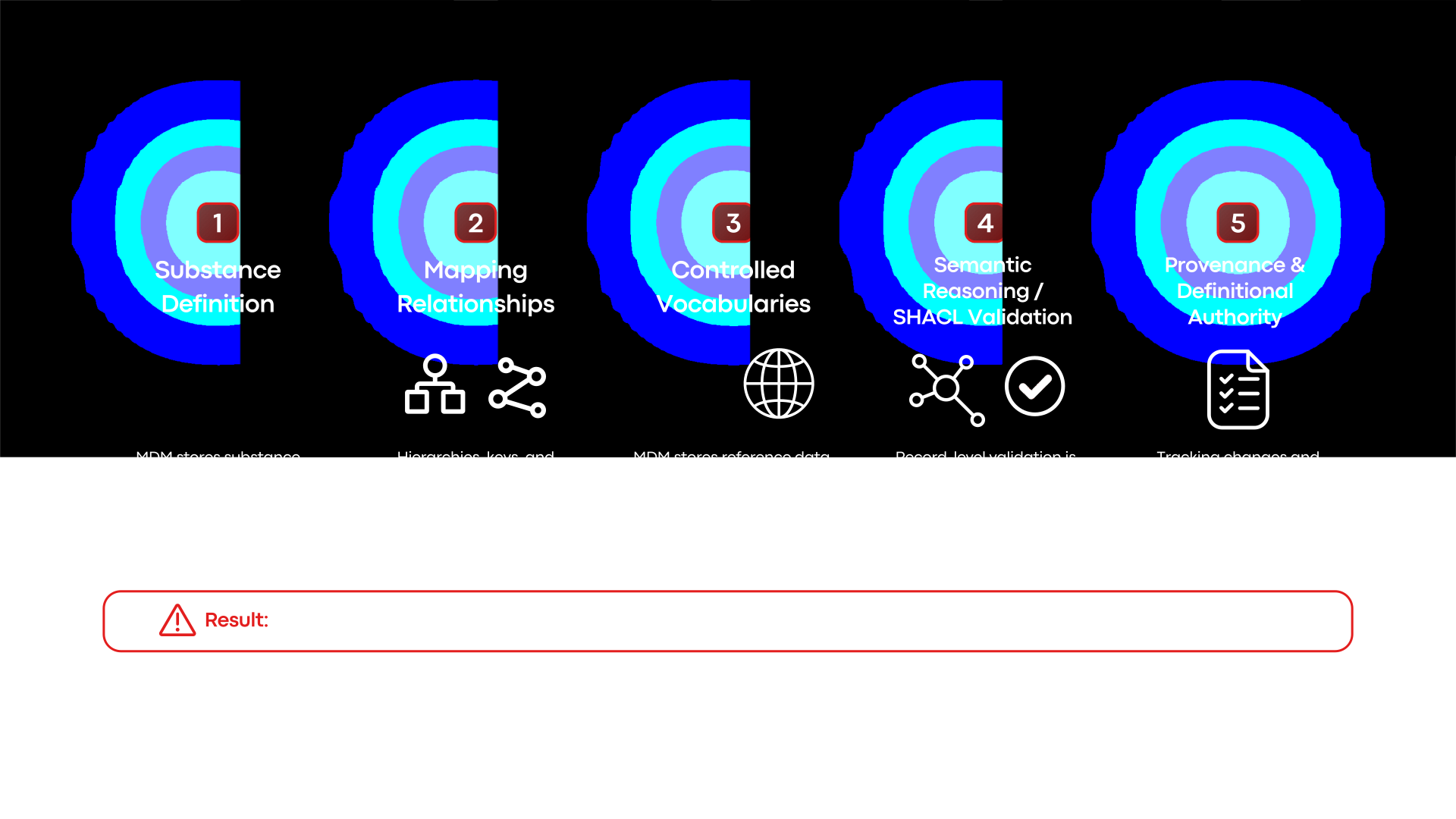
Five Gaps Where MDM Falls Short for IDMP
1. Substance Definition
IDMP distinguishes between concepts such as specified substances, mixtures, polymers, and structurally diverse materials. These are not simple classifications within a hierarchy. They represent formally distinct entities with different regulatory implications and relationship structures.
Traditional MDM architectures were not designed to capture this level of ontological distinction.
2. Mapping Relationships
MDM manages relationships through hierarchies, foreign keys, and attribute references. These mechanisms support integration but do not express formal meaning.
IDMP requires relationships that carry explicit regulatory significance. Ingredient roles, dose forms, routes of administration, and authorisation structures must be represented in ways that can be validated and interpreted consistently across systems.
3. Controlled Vocabulary Management
IDMP depends on controlled vocabularies maintained by organisations such as EMA, WHO, and EDQM.
While MDM platforms can store reference data, they generally do not manage the semantic implications of vocabulary changes, term deprecations, or evolving regulatory definitions. What appears to be a simple reference-data update can have broader consequences for submission validity and product interpretation.
4. Semantic Reasoning / SHACL Validation
Valid IDMP submissions depend on consistency across interconnected entities, including products, substances, ingredients, measurements, and regulatory procedures.
This requires validation across relationships rather than individual records. The capability resembles reasoning over a connected knowledge model more than traditional data-quality checking.
In practice, this can affect activities such as linking authorised products to substance definitions, validating safety-related product information, or ensuring that regulatory submissions reflect the correct product context across markets and lifecycle stages.
5. Provenance And Definitional Authority
IDMP also requires organisations to distinguish formally between different sources of authority and validation.
A substance definition confirmed by a regulatory authority is not equivalent to an internally maintained approximation. While MDM systems can record provenance metadata, they are not designed to represent these distinctions as computable semantic constructs.
The Deeper Pattern: Data Management Versus Semantic Precision
These five gaps share a common root.
MDM manages data as records, attributes, hierarchies, and workflows. It excels at governance, consistency, and operational control.
IDMP requires something different. It requires substance definitions, mapping relationships, controlled vocabularies, semantic validation, and authoritative provenance to be represented in ways that preserve formal meaning across systems.
This distinction becomes increasingly important when organisations move beyond compliance and begin exploring AI-enabled capabilities.
As discussed in the previous article, AI systems depend on more than structured data. They require context, lifecycle awareness, and explicit relationships between concepts. MDM captures what users enter into records. It does not capture the underlying domain knowledge that experts use when interpreting those records.
The result is often a system that supports operational processes well, but lacks the semantic structure needed to represent product meaning consistently across systems and use cases.
How an IDMP Semantic Layer Complements MDM
The limitations described above are not failures of MDM. They are the predictable result of applying a data management architecture to a semantic engineering challenge.
What many organisations ultimately require is an IDMP semantic layer that complements the MDM platform rather than replaces it.
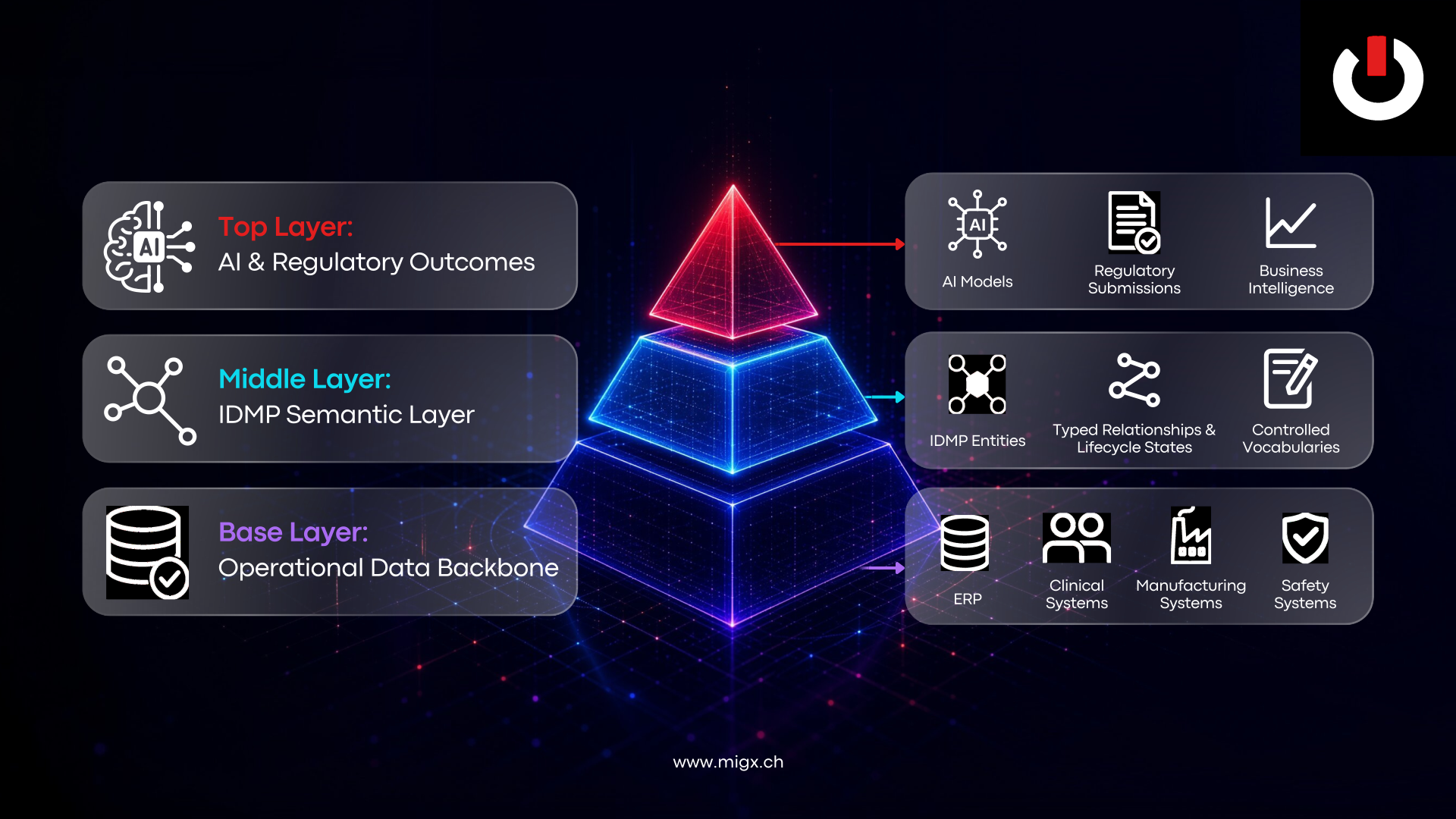
In practical terms, this means mapping product, substance, regulatory, and lifecycle concepts into a governed knowledge structure that can support controlled vocabularies, formal relationships, and cross-domain reasoning. MDM continues to provide the operational backbone, while the semantic layer supplies the precision needed for regulatory interoperability and AI-readiness.
For Life Sciences organisations, this creates a shared product understanding that can be applied consistently across regulatory affairs, clinical development, pharmacovigilance, manufacturing, and emerging AI-enabled workflows.
In practice, that semantic layer helps organisations establish:
- formal product and substance definitions
- typed regulatory relationships
- controlled vocabulary alignment
- cross-domain reasoning capability
- lifecycle state causality modelling
Seen through this lens, IDMP becomes more than a compliance initiative. It becomes a catalyst for building a product knowledge architecture capable of supporting both regulatory requirements and future AI use cases.
The next article in this series explores what that semantic layer looks like in practice, how it formalises expert knowledge, and why it plays a critical role in transforming product information into enterprise knowledge.
Conclusion
Organisations approaching IDMP through a master data management lens may achieve stronger governance, but they still need semantic precision to support interoperability, validation, and AI-ready product knowledge.
Organisations that approach IDMP purely as a data management initiative may achieve compliance while still struggling to support advanced validation, interoperability, and AI reasoning. Those that recognise the semantic dimension gain something more durable: a product identity that is consistent, traceable, and capable of supporting intelligence across the product lifecycle. This becomes increasingly important when product information must remain consistent across substance definitions, safety information, regulatory submissions, and lifecycle changes.
For Life Sciences organisations exploring AI readiness, this distinction is becoming increasingly important. At MIGx, we see IDMP not simply as a regulatory programme, but as an opportunity to establish the structured knowledge foundations that future AI systems will depend on.
The question is no longer whether product information is governed. It is whether it can be understood, interpreted, and reasoned over consistently across the enterprise..
Ready to Move Beyond Traditional Master Data?
We help Life Sciences organisations strengthen product semantics, knowledge modelling, and AI-ready information foundations that support interoperability, traceability, and regulatory alignment.
FAQs
Why is IDMP more than a Master Data Management initiative?
While Master Data Management focuses on data quality, governance, and consistency, IDMP also requires formal definitions, controlled vocabularies, provenance, and semantic relationships. These capabilities help preserve product meaning across regulatory, clinical, safety, and manufacturing systems.
What is an IDMP semantic layer?
An IDMP semantic layer is a structured knowledge model that represents medicinal products, substances, organisations, and regulatory concepts through formal relationships and governed terminology. It complements MDM by adding the semantic precision needed for interoperability and advanced validation.
Why are controlled vocabularies important in IDMP?
Controlled vocabularies ensure that medicinal products, substances, dose forms, routes of administration, and other regulatory concepts are described consistently. They improve interoperability, reduce ambiguity, and support reliable regulatory submissions.
How does IDMP support AI-ready product knowledge?
AI systems require more than structured records. They depend on context, relationships, provenance, and consistent meaning. By introducing semantic precision and governed product definitions, IDMP helps establish a stronger foundation for AI-ready product knowledge.
What is the difference between data and knowledge?
Data represents facts or observations, while knowledge captures the relationships, context, and meaning that allow those facts to be interpreted. Organisations may possess large amounts of data, but without structured knowledge, AI systems often struggle to reason effectively.
